SEO and SEM Services | Grow Traffic, Leads & Sales
Combine organic SEO and paid search marketing to reach the right customers, increase website traffic, and generate more qualified leads.
Introduction
Getting people to visit your website is important, but the real goal is to attract people who are interested in what you sell. This is where SEO and SEM can work together. SEO helps your website gain organic visibility, while SEM can help you reach potential customers through paid search campaigns.
For a business owner, using only one method may not always be enough. SEO and SEM can create a more balanced search marketing strategy. Organic search can build visibility over time, while paid campaigns can bring targeted visitors when you need them.
Table of Contents
- What Are SEO and SEM?
- SEO and SEM Difference
- Why Businesses Need SEO and SEM
- How Organic and Paid Search Marketing Work Together
- Important SEO Activities
- Important SEM Activities
- Practical Example
- Common Mistakes
- Best Practices
- Frequently Asked Questions
- Conclusion
What Are SEO and SEM?
SEO and SEM are two important parts of search marketing.
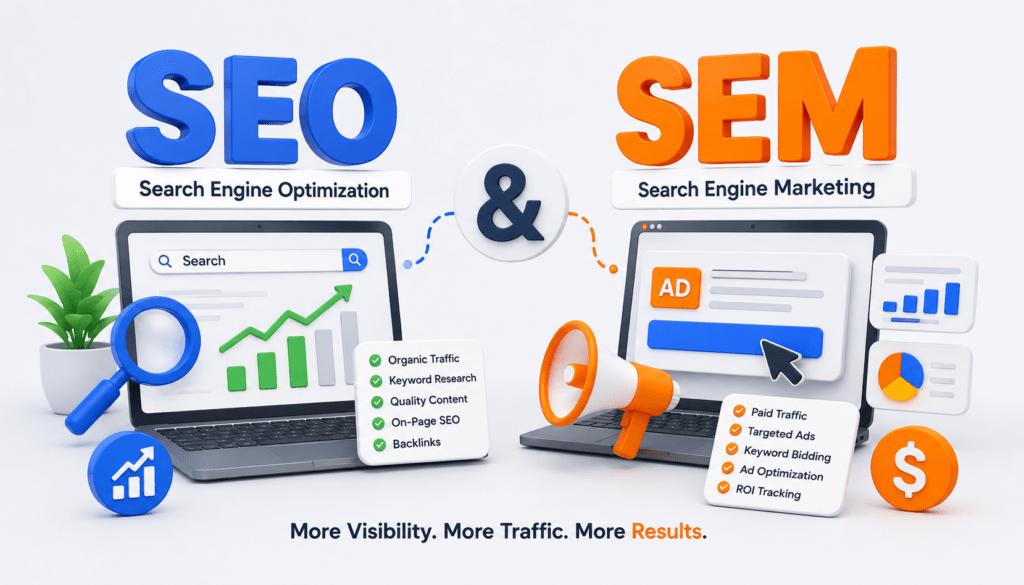
SEO stands for Search Engine Optimization. It focuses on improving a website’s organic visibility in search results.
SEM stands for Search Engine Marketing. In this article, SEM mainly refers to paid search advertising that allows businesses to show advertisements for selected search queries.
A simple way to understand is:
| Method | Main Focus | Main Benefit |
|---|---|---|
| SEO | Organic search | Long term visibility |
| SEM | Paid search | Faster targeted visibility |
| SEO and SEM | Combined strategy | Wider search presence |
SEO and SEM Difference
The biggest difference between SEO and SEM is how visibility is achieved.
SEO generally requires improving website content, structure, technical performance, and relevance. It can take time to produce meaningful results, but successful organic pages can continue attracting visitors.
SEM uses paid advertising to place your business in front of people searching for specific terms. It can provide visibility quickly, but you pay for the advertising activity.
For example, a company may use SEO to build long term visibility for educational searches while using SEM to promote an important service or seasonal offer.
Why Businesses Need SEO and SEM
Customers often search online before contacting a business. They compare websites, prices, services, reviews, and available options.
This makes a useful for businesses that want to reach customers during the search process.
A combined approach can help businesses:
- Increase search visibility
- Reach customers with strong buying intent
- Generate website traffic
- Test different marketing messages
- Increase qualified leads
- Understand customer search behavior
- Build long term organic visibility
The biggest advantage of SEO and SEM is flexibility. You can use organic search for sustainable growth while using paid campaigns when you need more immediate exposure.
How Organic and Paid Search Marketing Work Together
Organic and paid search marketing can support each other when planned properly.
Suppose a business is launching a new service. It may take time for a new SEO page to gain organic visibility. During that period, paid search can help bring relevant visitors to the page.
At the same time, the business can continue improving its organic content.
This makes a useful at different stages of the customer journey.
Search advertising can also provide useful information. If a particular keyword generates strong enquiries through paid campaigns, that information may help the business decide which topics deserve more attention through SEO.
Important SEO Activities
A successful SEO and SEM strategy should begin with a strong SEO foundation.
Keyword Research
Keyword research helps identify what potential customers search for.
Instead of choosing keywords only because they have high search volume, consider:
- Search intent
- Business relevance
- Competition
- Location
- Customer needs
- Buying stage
On Page SEO
On page optimization improves individual website pages.
It can include:
- Page titles
- Headings
- Useful content
- Internal links
- Image descriptions
- Clear calls to action
Technical SEO
Technical SEO focuses on website performance and accessibility.
Important areas include:
- Mobile usability
- Website speed
- Indexing
- Site structure
- Broken links
- Secure connections
These activities support SEO and SEM because paid visitors also need a website that works well.
Important SEM Activities
SEM requires careful planning because advertising costs can increase quickly without proper management.
A useful SEM campaign may involve:
- Keyword selection
- Audience targeting
- Advertisement writing
- Landing page optimization
- Budget management
- Conversion tracking
- Performance testing
The goal of SEO and SEM is not simply to generate clicks. The goal is to attract visitors who are likely to take a useful action.
Practical Example
Imagine a small digital marketing agency in Delhi wants more clients.
The agency starts with SEO content around services such as SEO, social media marketing, website development, and online advertising.
At the same time, it creates a paid search campaign for a few high intent searches.
The SEO pages gradually work toward stronger organic visibility. The paid campaigns bring immediate visitors and provide data about which keywords attract potential clients.
After reviewing the results, the agency can invest more effort in the topics that produce qualified enquiries.
This is a practical example of how SEO and SEM can work together instead of being treated as separate marketing activities.
Common Mistakes
Businesses often make simple mistakes when managing SEO and SEM.
Avoid these problems:
- Using keywords without understanding search intent
- Sending paid traffic to weak landing pages
- Focusing only on clicks
- Ignoring conversion tracking
- Copying competitor content
- Expecting instant SEO results
- Spending on too many paid keywords
- Ignoring mobile users
- Stopping SEO when paid campaigns perform well
Another mistake is treating organic and paid search marketing as completely separate. The best results often come when data from one channel helps improve decisions in the other.
Best Practices for SEO and SEM
If you are starting with SEO and SEM, keep the strategy simple and measurable.
- Define your business goal first
- Understand your ideal customer
- Research search intent
- Create useful website pages
- Improve technical SEO
- Test paid keywords carefully
- Track leads and conversions
- Review campaign performance regularly
- Improve weak landing pages
- Use organic and paid search marketing data together
From an experience based perspective, transparent reporting matters just as much as technical work. You should understand where your visitors come from and whether those visitors are helping the business.
Frequently Asked Questions
What are SEO and SEM?
SEO and SEM are search marketing methods. SEO focuses mainly on organic visibility, while SEM commonly refers to paid search advertising.
Are SEO and SEM the same?
No. They are related but different. SEO focuses on improving organic search visibility, while SEM can involve paid search campaigns.
Which is better, SEO or SEM?
Neither is automatically better. SEO can support long term organic growth, while SEM can provide faster paid visibility. Using SEO and SEM together can be useful for many businesses.
How long does SEO take to show results?
There is no fixed timeline. Results depend on competition, website quality, content, technical health, authority, and consistency.
Is SEM expensive?
SEM costs depend on the keywords, competition, audience, budget, and campaign quality. Proper tracking is important so you can understand whether advertising spend is producing valuable results.
Can SEO and SEM generate leads?
Yes. SEO and SEM can generate leads when campaigns target relevant searches and the website provides a clear path for visitors to contact or buy from the business.
Conclusion
SEO and SEM can give businesses a practical way to reach customers at different points in the search journey. SEO builds organic visibility through useful content and website improvements, while SEM can provide targeted paid visibility when immediate exposure is needed.
The strongest strategy is not necessarily the one with the biggest budget. It is the one that understands the audience, targets relevant searches, provides useful information, and measures meaningful business results. conversion tracking, and clear reporting, businesses can create a more balanced search marketing strategy.
Organic and paid search marketing should not be viewed as completely separate activities. When the data from both approaches is used intelligently, each can help improve the other.
CTA
If you want to grow your search presence, start by identifying the searches your customers use before contacting your business. Then decide which opportunities are better suited to SEO, which may benefit from SEM, and where organic and paid search marketing can work together. A focused plan is a better starting point than trying to do everything at once.